The Last
Mile.
Johns Hopkins Center for Communication Programs commissioned White Rice to create a globally deployable, culturally resonant training animation series for the world’s frontline immunization workforce — people working at the last mile of healthcare, where vaccines reach the children who need them most.
Creative & Communication Design for a Global Health System
Johns Hopkins Center for Communication Programs — one of the world’s leading health communication institutions — engaged White Rice as their creative partner and communication design firm for a landmark global initiative: building a comprehensive animation-based training package for frontline immunization workers spanning four continents. Our mandate was to conceive, design, and produce content that could work everywhere — culturally representative, scenario-grounded, and powerful enough to train, challenge, and equip health workers operating in radically different settings.
Key Outcomes
Global Deployment · One Framework, Four Worlds
The same vaccine. The same child. Four entirely different communities.
Africa
Sub-Saharan · Last-Mile Communities
Rural and peri-urban communities where trust in health systems is hard-won, infrastructure is limited, and FLWs navigate significant cultural and logistical barriers to reach every child on their list.
Asia
South & Southeast Asia · Dense & Dispersed
From densely packed urban settlements to geographically remote villages — FLWs in South and Southeast Asia encounter everything from vaccine hesitancy among educated parents to access challenges in mountainous and flood-prone terrain.
Gulf
Middle East · Migrant & Mixed Communities
Complex multi-cultural and migrant community contexts where religious norms, language diversity, and community trust all shape FLW interactions in ways that demand specific cultural competency and communication sensitivity.
Europe
Western Europe · Diaspora & Underserved
Underserved migrant and diaspora communities where FLWs encounter vaccine misinformation, language barriers, and deep distrust of government health systems — requiring entirely different negotiation and communication strategies.
Creative Design Challenge · Universal Without Being Generic
Without belonging to no one.”
The three creative design principles that guided every episode — from character design and scenario selection to animation style, voiceover direction, and language adaptation.
Archetypal Characters
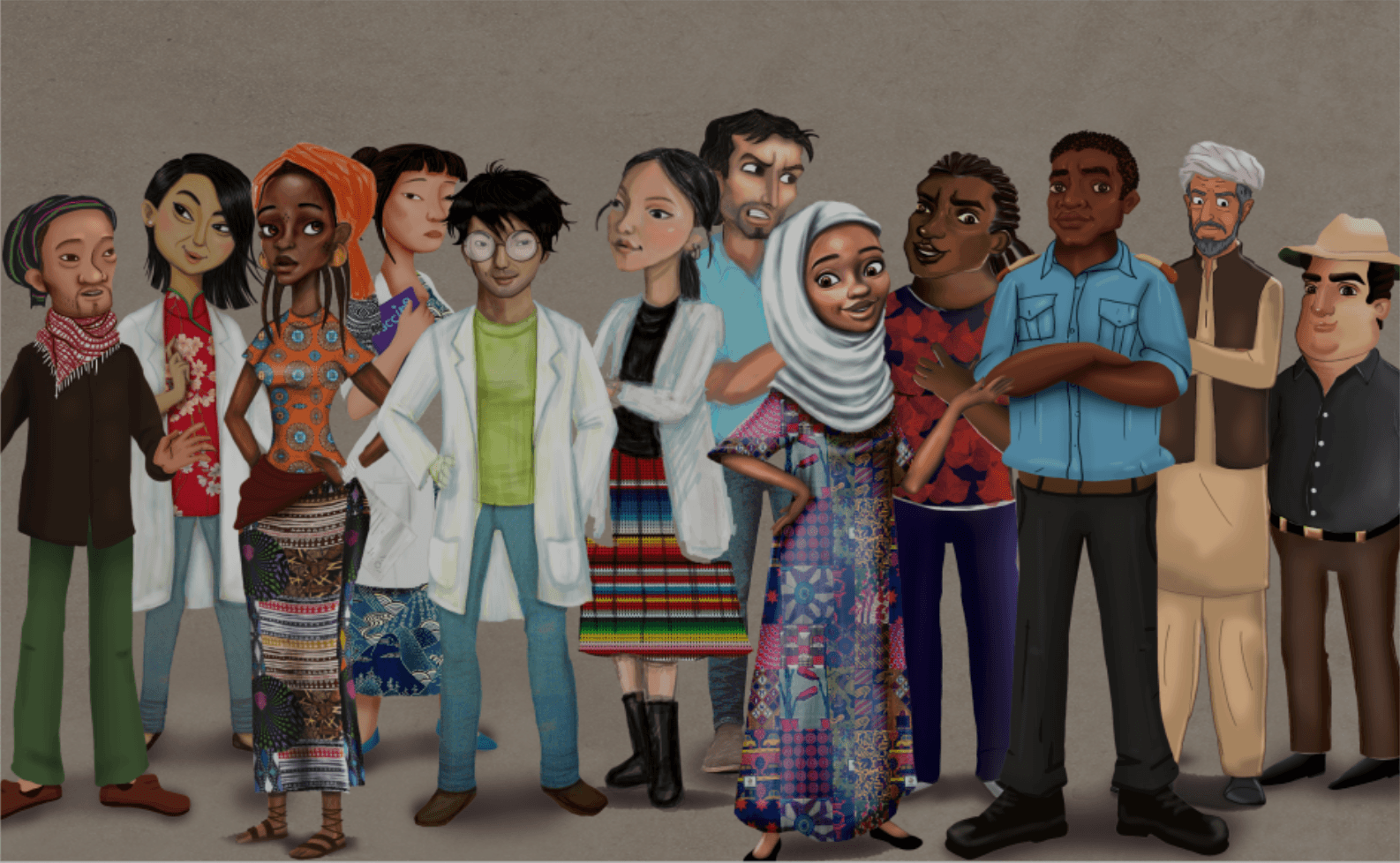
Characters were designed to represent recognisable human archetypes — the hesitant father, the community gatekeeper, the sceptical grandmother, the exhausted mother — without being anchored to a specific nationality, religion, or ethnicity. Viewers across four continents recognise these people because they know them.
Scenario-First Structure
Each episode began with a situation, not a message. The FLW encounters a real-world barrier — misinformation, refusal, access difficulty, cultural resistance — and the episode shows what skilled, compassionate communication looks like in that moment. Learning emerges from narrative, not instruction.
Mobile-Native Design
Every visual and pacing decision was made for a phone screen in the field — high-contrast imagery, minimal visual complexity, short episode duration, and a structure that allows a worker to revisit a specific episode before a community visit without watching the entire series again.
The Animation Series · Six Episodes · Six Scenarios
Every episode a different door.
Every door a real situation a frontline worker will face.
Episode 01
The Resistant Household
Scenario: Vaccine Hesitancy & Refusal
A family refuses vaccination — citing misinformation, fear, or religious concern. The episode models how an FLW listens, builds trust, addresses specific concerns without confrontation, and creates the conditions for a different decision.
Episode 02
The Gatekeeper
Scenario: Community Influencer Barriers
A community leader, religious figure, or influential family member is blocking access. The episode explores respectful engagement with gatekeepers — how to bring them into partnership rather than around them, without compromising the vaccination goal.
Episode 03
The Unreachable Village
Scenario: Geographic & Access Barriers
Distance, terrain, and logistical difficulty create barriers to reaching a family or community. The episode shows problem-solving, community mobilisation, and the creative persistence that effective last-mile health delivery requires.
Episode 04
The Misinformation Moment
Scenario: Social Media & Rumour Dynamics
A community is circulating misinformation — spread through social media, peer networks, or traditional rumour channels. The episode equips FLWs to address false information with evidence-based, emotionally intelligent communication strategies.
Episode 05
The Second Visit
Scenario: Missed Doses & Follow-Through
A child missed a scheduled dose and the family is disengaged. The episode addresses how FLWs re-engage without blame — rebuilding the relationship and the family’s commitment to completing the immunization schedule.
Episode 06
The Community Champion
Scenario: Peer Advocacy & Positive Deviance
An FLW identifies and activates a community member as a positive deviant — someone whose voice carries more trust than the health system’s. The episode models the peer-to-peer approach that turns individual behaviour change into community norm shift.
Localisation · Same Content, Four Worlds
One story.
Four voices.
Four communities.
Primary Language
English
Master version — for global deployment, Western Europe, and international training facilitation. Scripted as the source language for all localisation.
Africa & Global Reach
French
Serving Francophone Africa and French-speaking communities in Western Europe — critical for the Sub-Saharan African deployment cohort.
Asia · South & Southeast
Urdu / Hindi
For South Asian deployment contexts — Pakistan, India, and the South Asian diaspora communities in the Gulf and Western Europe cohorts.
Gulf & MENA Region
Arabic
For Gulf and Middle Eastern deployment, and Arabic-speaking migrant and diaspora communities across all four deployment regions.
Distribution & Deployment · From Classroom to Field
The training that fits in a pocket.
The animation series was designed not as standalone content but as the experiential core of a larger Johns Hopkins CCP training architecture. It was integrated into formal FLW training programmes — used to introduce scenarios, prompt group discussion, and ground participants in the human reality of their work before moving to technical instruction.
Critically, the series was then converted into a mobile-accessible reference guide — allowing workers to revisit specific episodes in the field before a difficult visit, without needing internet access or classroom infrastructure. The content that trained them in a room was available in their hand at the moment they needed it most.
Mobile-First
Converted to a hands-on phone-based reference guide — accessible to FLWs without internet, optimised for low-bandwidth and offline viewing
Global Training Integration
Embedded within Johns Hopkins CCP’s full FLW training package — used as the scenario-based learning core of in-person and remote training sessions
Global Network Deployment
250,000 frontline workers across Africa, Asia, Gulf, and Western Europe given access — deployed through UNICEF-aligned and Johns Hopkins CCP global networks
On-Demand Reference
Workers can revisit individual episodes by scenario type — making the training a live field resource, not a one-time classroom event
The Challenge
The brief from Johns Hopkins CCP was as technically demanding as any White Rice had received. The training content needed to be simultaneously universal and specific — meaningful to a health worker in Nairobi and to one in Karachi, to one in Cairo and to one in Birmingham. It needed to depict real situations without privileging any single cultural context. It needed to be producible in four languages without losing its emotional or instructional impact in translation. And it needed to work on a phone screen in the field — not just in a training room.
The core tension in the brief was between specificity and universality. Health communication works through recognition — a viewer needs to see themselves or their community in the scenario to engage with it. But a scenario that is too specific to one context alienates every other. White Rice's creative challenge was to build characters, situations, and community dynamics specific enough to feel real, but archetypal enough to travel across continents.
Overlaid on the creative challenge was a rigorous instructional one: the animations needed to function as genuine training tools within Johns Hopkins CCP's broader FLW capacity-building programme — not as awareness content, but as practical scenario-based learning that changed how workers showed up in the field.
The hardest design problem is not making something powerful. It is making something powerful that means the same thing to different people in different worlds — and still moves all of them to act.
The Strategy
White Rice worked closely with Johns Hopkins CCP’s global teams — building an understanding of the specific field situations, community dynamics, and communication challenges that FLWs encounter across the programme’s four deployment regions. This research informed the scenario design: each episode was built around a real situation type, not an invented one.
The Impact
The programme’s impact is measured not in views or impressions, but in the 250,000 frontline workers who entered the world’s most difficult healthcare environments better equipped — with a clearer understanding of the human situations they would face, and better communication tools for navigating them. Every child vaccinated through those interactions is the programme’s ultimate unit of success.
Working with Johns Hopkins CCP required White Rice to operate at a scale and rigour we rarely encounter — global stakeholders, global deployment, global ambition. The result was a training tool that was both technically credible enough for Johns Hopkins and humanly compelling enough for a health worker at 6am on a difficult village visit. That balance is what we are most proud of.
The last mile is
not a geography.
It is a conversation.
250,000 frontline workers. Four languages. Four continents. Six situations every one of them will face. Walidain HumQadam gave parents the tools to show up for their children. This gave the health workers who serve those families the same — a way to understand the human being on the other side of the door, before they knock.