The World
Against the Girl.
What began as an animated campaign for 16 Days of Activism became Pakistan’s most powerful advocacy movement for girls’ right to education , earning a $1 million grant, producing Pakistan’s first Children’s Assembly, and shifting the national conversation for years to come.
From Campaign Spark to National Movement Architecture
White Rice designed Dunia Aali Larki from its first frame to its national scale , beginning with the animated campaign film that launched on 16 Days of Activism, and growing through four years of advocacy into a multi-tier movement spanning policymakers, schools, communities, media, and Pakistan’s first Children’s Assembly. Our role spanned creative strategy, animation production, grassroots mobilisation design, school programme development, policy dialogue facilitation, and digital amplification , all in service of one sustained demand: that girls in Pakistan have the right to learn.
Key Outcomes
children.
No school.
The Arc · From Spark to Sustained Movement
One animated film.
Four years of national change.
The Spark
Animated Campaign Film
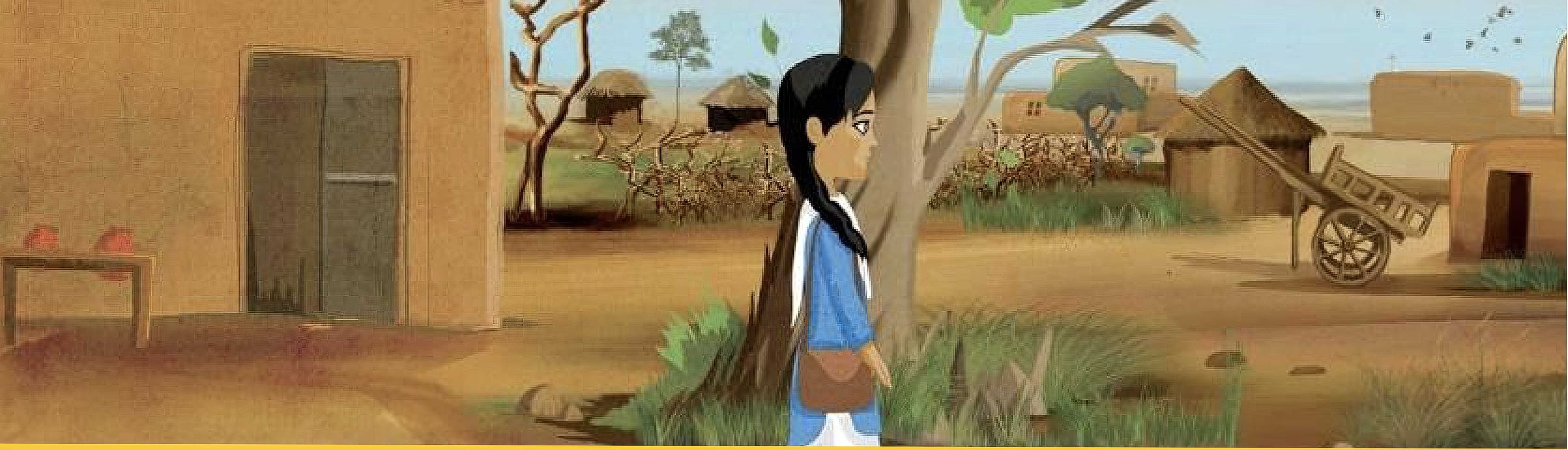
Launched on November 25th for 16 Days of Activism , a bold, emotionally resonant animated film showing the disparity and compounding challenges a girl faces in Pakistan. Aired on TV and amplified across digital platforms.
The Catalyst
$1M Grant Secured
The campaign’s resonance demonstrated to funders that Pakistan was ready for a sustained movement on girls’ education. Oxfam secured a $1 million grant to expand from 16 days to a 4-year national advocacy programme.
The Movement
4-Year National Advocacy
A full socio-ecological model campaign , operating simultaneously at policy, community, school, and digital levels, culminating in Pakistan’s first Children’s Assembly and a lasting shift in the national conversation.
Socio-Ecological Model · Designed for Every Tier of Influence
A movement works when everyone hears it
in the language that belongs to them.
Enabling Environment
Policy & Government
Institutional
Schools & Educational Bodies
Community
Local Influencers & Leaders
Family
Parents & Caregivers
Individual
Girls & Children
Campaign Centrepiece · Pakistan’s First
The Children’s Assembly.
First.
The Children’s Assembly was the campaign’s most audacious and most enduring achievement. For the first time in Pakistan’s history, children formed their own parliament , a Children’s Assembly , and convened at a national convention centre in Islamabad to debate the right of girls to education at a national assembly level.
This was not a symbolic exercise. The debates were substantive, the participants were prepared, and the audience included political figures who served as moderators , lending the proceedings genuine institutional weight and sending an unmistakable message: the children of Pakistan are not waiting for adults to solve this for them.
National Convention Centre, Islamabad , a deliberate venue choice that gave children the stage their arguments deserved, not a school auditorium
Children’s Parliament format , structured debate with elected child representatives arguing for girls’ right to education in front of peers, parents, politicians, and press
Political figures as moderators , not keynote speakers, but moderators: listening to children debate, not the other way around
National media coverage , the Assembly generated press coverage that no advocacy report or policy brief could match, putting children’s voices at the centre of the national education conversation
Target Audiences · Everyone Who Shapes a Girl’s Future
The campaign had one message
and eight different audiences to deliver it to.
Government & Policymakers
Provincial and federal government , targeted through dialogues, the global conference, and the Children’s Assembly to drive policy reform on girls’ education.
Donors & NGOs
International and national funders , shown a credible, scaled movement that justified continued and increased investment in girls’ education in Pakistan.
Educational Institutions
Schools and universities , engaged through club programmes and the Children’s Assembly to become active programme partners rather than passive beneficiaries.
Parents & Teachers
The day-to-day gatekeepers of girls’ access to education , reached through school clubs, rallies, community events, and mass media to shift the household-level calculation.
The Challenge
Pakistan’s girl-child education crisis is not a secret. It is a well-documented, frequently reported, consistently underfunded emergency. 36 million children are out of school, and girls represent the majority of the excluded , kept home by a combination of poverty, patriarchal norms, distance, safety fears, early marriage, and institutional indifference. The problem is known. The barrier has always been the will to act , at the level of government, community, and family simultaneously.
Oxfam needed more than a public awareness campaign. Awareness of the crisis was not lacking , what was lacking was the social permission, political urgency, and grassroots momentum that would translate awareness into action across every tier of the system. Inspired directly by the Nike Girl Effect model, Oxfam and White Rice set out to do for Pakistan’s girl-child education movement what that global initiative had done globally: make it feel like a cause that belonged to everyone.
The 16 Days of Activism window (November 25 to December 10) provided the launchpad. The question was what to put on it , something with enough emotional power to spark a movement, and enough strategic architecture to sustain one for four years.
You cannot fix with a school what a community has already decided. The campaign had to change the decision before it could change the enrolment numbers.
The Strategy
White Rice’s strategy was built on three convictions: that storytelling , not statistics , moves people; that a movement needs architecture, not just energy; and that the socio-ecological model is not a theory to cite in a report, it is a design brief for reaching everyone who matters simultaneously.
The Impact
Dunia Aali Larki accomplished something that most advocacy campaigns do not: it outlasted itself. The programme formally ended, but the movement it built did not. Other organisations working on girls’ education in Pakistan found themselves operating within a changed landscape , one in which their work had a stronger voice, a more receptive public, and a clearer precedent for what advocacy on this subject could look like.
The most significant impact of Dunia Aali Larki was not a number. It was the moment a Pakistani girl stood at a podium in a national convention centre in Islamabad, looked at a panel of politicians, and made the case for her own right to be educated. That moment was designed. And it changed something.
A 16-day campaign.
A four-year movement.
A girl at a podium.
Dunia Aali Larki proved that a single, well-designed creative moment , an animated film that told the truth about a girl’s life in Pakistan , can be the beginning of something much larger than a campaign. When the movement is built right, it doesn’t end when the funding does. It becomes part of the air the sector breathes.