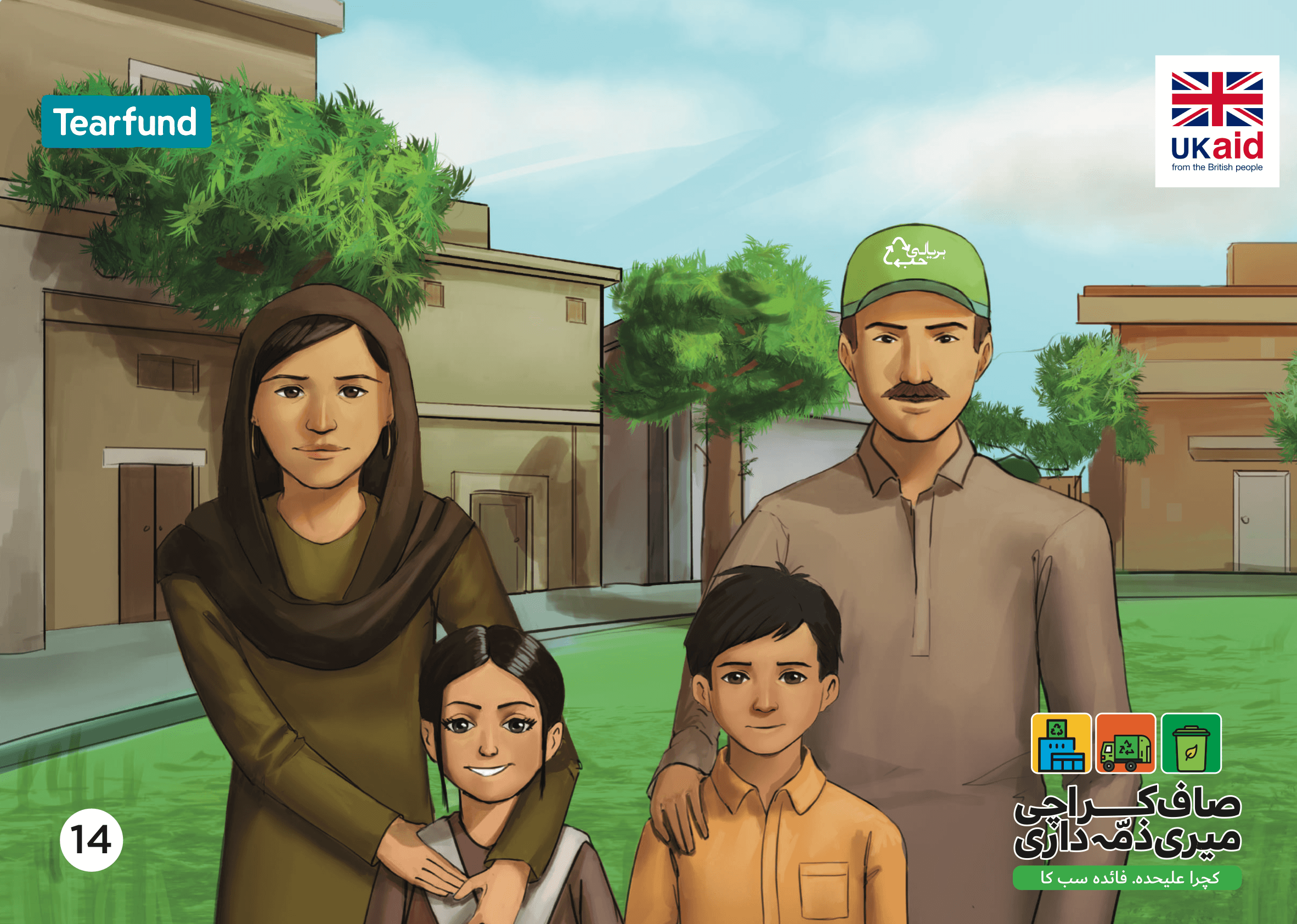
Clean Karachi
Is My Responsibility
A full-spectrum community behaviour change campaign designed to shift Karachi’s waste practices from household to hub — turning dry–wet segregation, collection, and recycling into a community movement, not a government mandate.
SBC Strategy, Campaign Design & Creative Lead
White Rice designed the complete behaviour change strategy and communication campaign for the Saaf Karachi Meri Zimmedari initiative — from formative research and community engagement, through to household nudge design, social mobiliser toolkits, animation production, mass media, incentive architecture, and community recognition programmes. Working alongside local government, collection teams, and the Hariali Hub recycling centre, we built a campaign that touched every actor in the recycling chain.
The Recycling Chain — How the System Was Designed to Work
Household Segregation
Families separate dry and wet waste at source using colour-coded bins and kitchen nudges
Collection Vehicles
Government-run segregated collection vehicles pick up pre-sorted waste from communities
Hariali Hub
Local recycling centre receives and further sorts the collected material by type
Recycled Products
Dry waste processed into driveways, construction materials, and reusable products
Organic Fertiliser
Wet waste converted into compost and fertiliser — closing the loop from kitchen to soil
Key Outcomes
Collect.
Recycle.
The Challenge
Recycling was not part of how Karachi’s low-income communities understood waste. Waste was disposed of — often wherever was most convenient — not sorted, segregated, and handed to a collection vehicle for a journey to a recycling hub. The concept of a Hariali Hub, of dry versus wet waste, of plastics being turned into driveways — all of it was genuinely new.
The campaign had to work across multiple segments simultaneously — women managing household waste, men and youth who influenced community norms, local influencers and religious leaders whose endorsement could shift social permission, waste collectors who needed to be part of the solution rather than bypassed by it, and government partners whose collection infrastructure only worked if households had already done their part.
Behaviour change in this context also meant confronting deeply ingrained norms in communities where open dumping was normalised, where waste bins at home were uncommon, and where the connection between household practice and city-level cleanliness had never been made visible. White Rice’s role was to make that connection — and to make it feel urgent, achievable, and personally meaningful.
In a community that has never encountered recycling as a practice, the first job is not to motivate the behaviour. It is to make the behaviour imaginable.
The Strategy
White Rice began with in-context qualitative research — observations, one-on-one interviews, and focus group discussions across target communities — mapping current waste disposal practices, identifying the moments where behaviour broke down, and understanding what would make long-term change possible rather than just compliance in the short term. The strategic framework that emerged was built around four simultaneous layers of activation: the household, the community, mass media channels, and the incentive architecture that connected and rewarded performance across all of them.
Household-Level Design
Where behaviour change begins — in the kitchen.
The household was the first and most critical site of intervention. Before any community session or media campaign could take effect, the home needed to have the physical tools and environmental nudges to make the new behaviour the path of least resistance.
Colour-Coded Waste Bins
Designated bins for dry and wet waste — making segregation a physical act built into the daily kitchen routine, not a decision that required thinking each time.
Kitchen Nudges & Doorstickers
Visual reminders placed at the point of behaviour — on bin lids, refrigerators, and above waste disposal areas — reinforcing the habit at the exact moment it needed to happen.
“I Am a Clean Champion” Identity Sticker
A household identity marker that connected the family’s private practice to a larger community movement — turning domestic behaviour into a public statement of values and belonging.
WhatsApp Behaviour Nudges
Regular reminder messages and animated content delivered directly to household members — keeping the behaviour salient between social mobiliser visits and community sessions.
Incentive Architecture · Everyone Has a Role. Everyone Gets Recognised.
A rewards system designed to motivate every actor in the chain.
Top Performers
Champion Households
Families with the highest and most consistent segregation performance recognised publicly — creating social aspiration around the behaviour and peer competition as a driver of change.
Best Performers
Top Communities
Whole communities recognised and celebrated for collective performance — making clean neighbourhoods a source of community pride, not just individual compliance.
Frontline Staff
Social Mobiliser Scorecards
Performance tracking and recognition for social mobilisers — acknowledging frontline effort and creating accountability with appreciation rather than just monitoring.
Collection Teams
Collector Awards
Recognition for top-performing waste collectors — treating them as essential programme champions and giving their contribution the visibility and dignity it deserved.
360° Campaign Architecture
Every channel working together — from the kitchen wall to TikTok.
Community & Outdoor
Digital & Social Media
Field & Household
The Impact
Saaf Karachi Meri Zimmedari succeeded in doing what most recycling campaigns fail to do: making waste segregation feel like a community movement rather than a government instruction. By incentivising every actor in the recycling chain — from the household to the collector — and by making the behaviour visible, celebrated, and competitively desirable, the campaign created momentum that institutional programming alone cannot generate.
What made this programme distinctive was the decision to treat recycling not as an environmental message but as a civic identity. Saaf Karachi Meri Zimmedari gave communities something to be proud of — a claim of ownership over their city that could be expressed every time they sorted their waste. That is the shift that lasts beyond any campaign cycle.
When a city takes
ownership of its own cleanliness,
no campaign is needed.
Saaf Karachi Meri Zimmedari set out to make recycling possible in communities that had never practised it. What it created instead was something larger: a shared civic pride in a city that belongs to its people — and a responsibility they chose to carry.