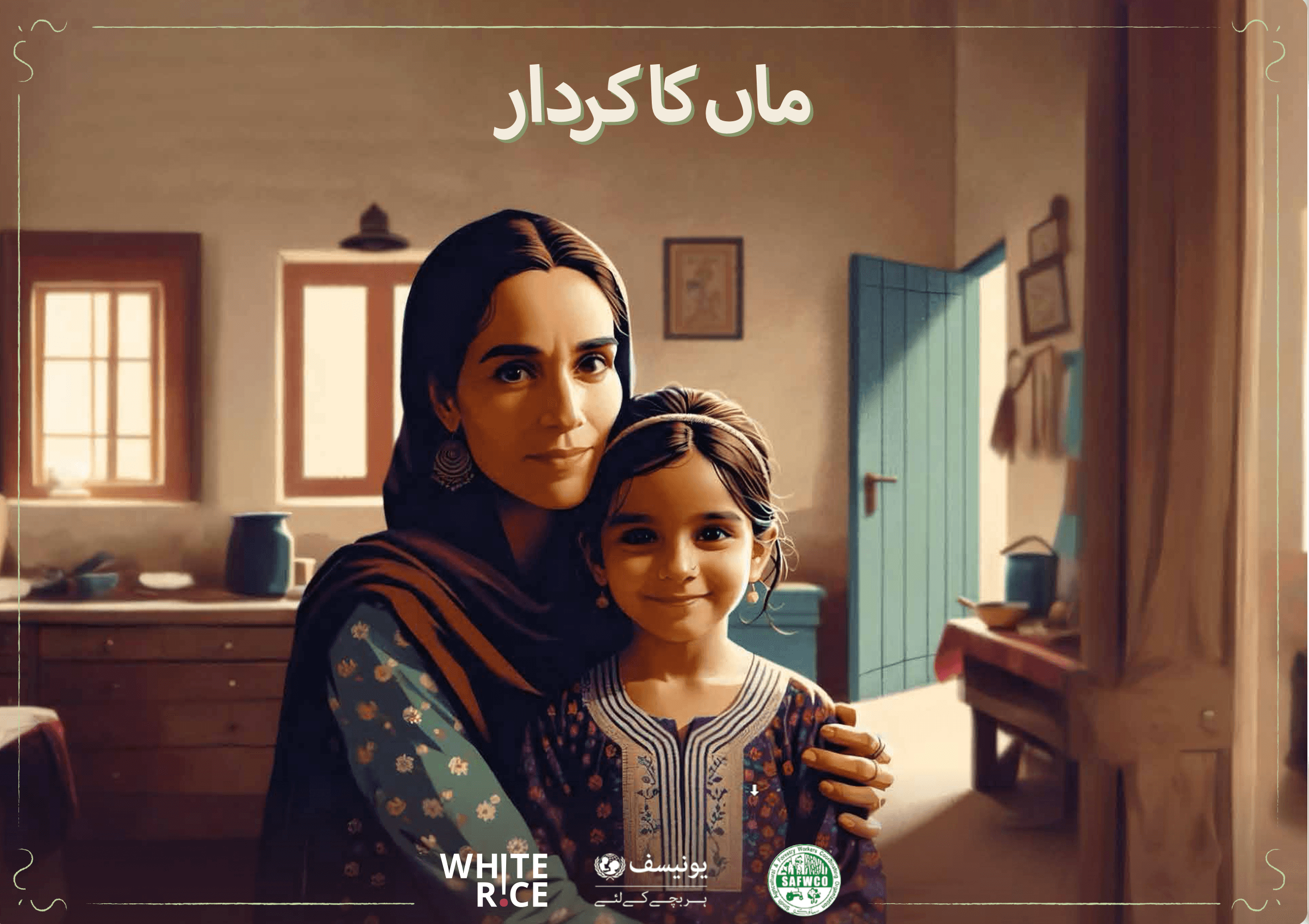
White Rice20 YEARS
Menstrual Health · Period Poverty · Social Behaviour Change
UNICEF Pakistan · Rajanpur (Punjab) & Battagram (KPK)

Breaking Barriers

Advancing Menstrual Health in Pakistan with Social Behaviour Change, Phase II

A national SBC initiative to dismantle the silence, shame, and misinformation surrounding menstrual health and hygiene in rural Pakistan, designed across three provinces, three target audiences, and the full socio-ecological model, with a 90% communication effectiveness rate and readiness for national rollout.

Year2021 – 2023
ClientUNICEF Pakistan
ProvincesSindh (Pilot 1) · Punjab · KPK
FocusMenstrual Health & Hygiene SBC
White Rice RoleSBC Strategy, Co-Creation & Toolkit Design Lead
Our Role

SBC Strategy, Co-Creation & National Toolkit Design

White Rice served as UNICEF's SBC strategy and creative partner across the full programme cycle, from a national study and community co-creation workshop in Sindh, through the design of Pakistan's first MHH SBC Toolkit, to the Phase II scale-up across five villages each in Rajanpur (Punjab) and Battagram (KPK). Every element of the programme, conversation guides, storybooks, training materials, monitoring systems, was designed by White Rice with and for the communities it served.

National Study & Formative ResearchCommunity Co-CreationSBC Toolkit DesignKAB Framework DesignCRP Training ProgrammeConversation Flip BooksGirls' StorybookMonitoring & Data SystemProvincial Scale-Up Design
01

Key Outcomes

~90%
Communication toolkit effectiveness rate across all three provincial pilots, validating readiness for nationwide rollout.
3 Provinces
Sindh, Punjab, and KPK, three culturally and contextually distinct provinces, one tested and refined SBC toolkit.
3,000+
Fathers, mothers, and adolescent girls reached across 10 villages in Rajanpur and Battagram through structured KAB sessions.
Hypotheses Overturned
Every assumption about male resistance and community reluctance was disproved, fathers emerged as the programme's most engaged and vocal participants.
National Toolkit
Pakistan's first MHH SBC Toolkit, ready for national rollout and replicable by any partner organisation across all regions.
49%
of girls.
No knowledge.
In Pakistan, nearly half of all girls experience their first period with no prior knowledge of menstruation. 44% lack access to the facilities needed to manage their menstrual health. The resulting stigma, shame, and health risk is not a natural state of affairs, it is the product of silence, and silence can be broken by design.

The Challenge

Menstrual health and hygiene in rural Pakistan is not simply a product access problem. It is a deeply entrenched social norm problem, one shaped by shame, silence, misinformation, and the complete absence of open dialogue between the people who need to have it most: fathers and daughters, mothers and sons, women and their own bodies.

White Rice and UNICEF's 2021–2022 national study identified four intersecting root causes: socio-cultural norms and behaviours; product affordability; accessibility barriers; and inadequate WASH infrastructure. Any programme that addressed only one of these would fail. And any programme built around information alone, without addressing the relational and normative context in which that information needed to travel, would reach no one.

Phase II added a further layer of complexity: scaling an approach that had worked in Sindh's Khairpur into two entirely new provincial contexts, conservative, patriarchal Rajanpur in Punjab, and the hilly, remote villages of Battagram in KPK. Both had been identified as likely to resist. Both would prove more open than anyone expected.

If I speak to my mother about this, she will kill me.

The Strategy

The strategy was built on three foundational commitments: co-creation with the community before designing anything; a Knowledge-Attitude-Behaviour (KAB) framework that moved participants through a structured arc rather than attempting single-session awareness; and a radical inclusion of fathers as primary programme participants rather than afterthoughts.

01
Co-Creation First
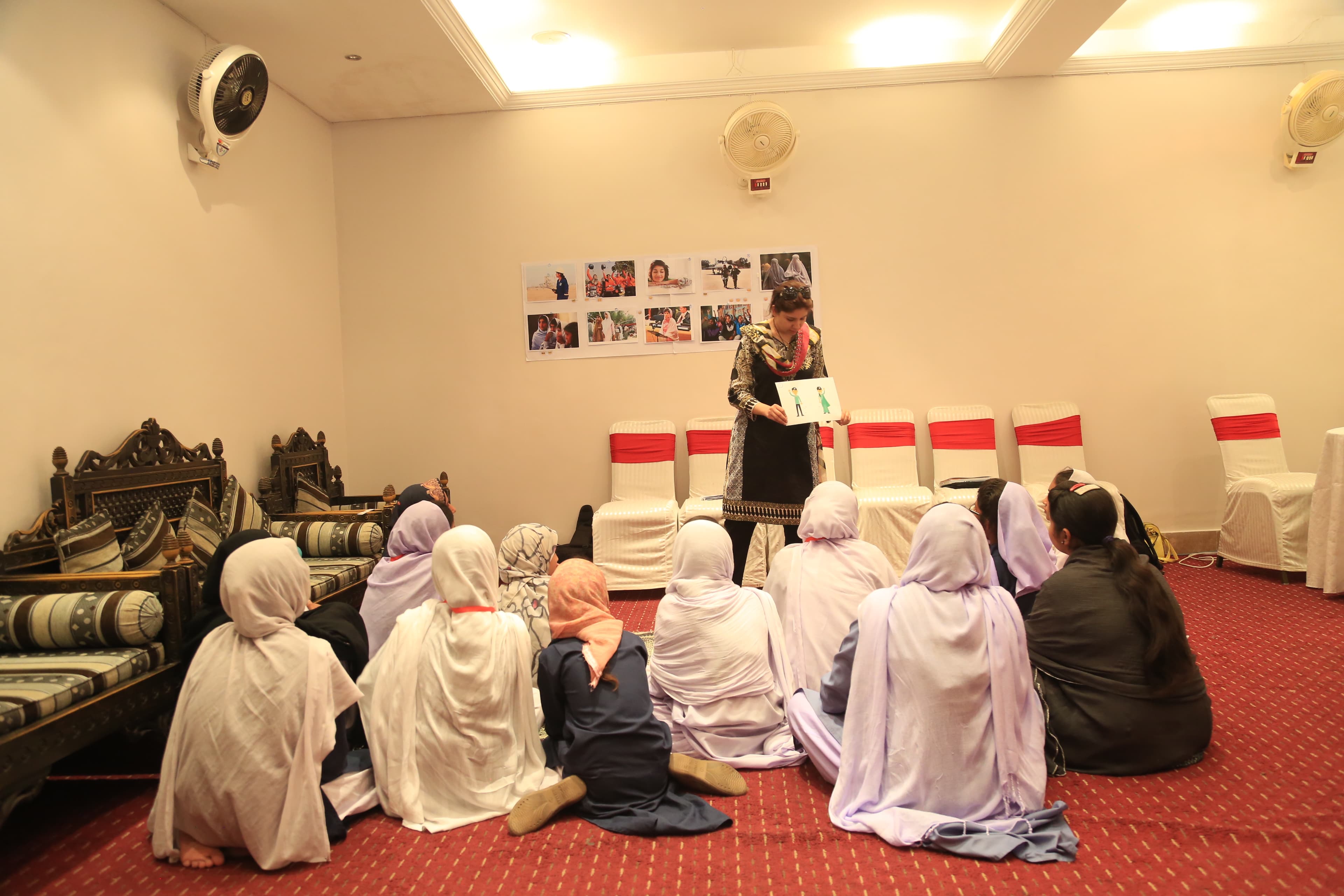
A 3-day embedded co-creation workshop in Khairpur, with women, girls, mothers, fathers, and community influencers, shaped the entire communication toolkit from the ground up, including multiple rounds of prototyping and real-community testing.
02
The KAB Arc
Three staged sessions per audience, Stage 1: Knowledge (large group, open conversation); Stage 2: Attitude (smaller groups, identify barriers); Stage 3: Behaviour + Intention (one-to-one or small group, pledges, action, storytelling from early adopters).
03
Fathers as the Enabling Environment
In Pakistan's rural context, the father is the breadwinner and decision-maker. Without his knowledge, empathy, and financial support, no behaviour change in the home is sustainable. Fathers were treated as equal participants, not obstacles to manage.
04
Storytelling as the Primary Vehicle
The girls' guide was built around Sara and Saba, two fictional characters whose stories provided an emotionally safe entry point for adolescent girls to engage with MHH without the shame of direct instruction or clinical information delivery.
The Programme Journey · Five Phases
Phase 1
Understand
National study to map root causes of period poverty across Pakistan
Phase 2
Co-Create
3-day co-creation workshop in Khairpur, Sindh with community members
Phase 3
Design
SBC toolkit & communication materials designed and prototyped iteratively
Phase 4
Implement
Pilot in Sindh followed by Phase II scale-up in Punjab & KPK
Phase 5
Scale Up
National toolkit finalised for rollout across Pakistan with partners
Target Audiences · Designed for Each Relationship in the Chain
Target 1
Father
The Enabler
The key decision-maker and breadwinner. His empathy and financial support are prerequisites for any behaviour change at home. Historically excluded from MHH discussions entirely.
Incentive: Long-term family health, religious duty of cleanliness, and the financial logic of prevention over treatment.
Target 2
Mother
The Relator
The direct caregiver who can empathise and act as a bridge between husband and daughter. But she faces her own shame and relational barriers that needed to be named and supported before she could lead change.
Incentive: Daughter's health, access to products for herself, and ability to give her family what they need.
Target 3
Adolescent Girls
The Bridge (Punjab) / Elder Sister (KPK)
The primary beneficiary, but also the most silenced. In Punjab, girls would only speak to their mothers; in KPK, elder sisters performed this bridge role. The storybook approach bypassed shame through narrative rather than instruction.
Incentive: Personal health, safety, and the right to ask for what they need.
Target 4
Community Influencers
The Norm Builder
Elders, religious leaders, and local figures whose endorsement signals community permission. In Battagram, a local Molana's positive engagement created immediate credibility and shifted the room's openness within a single session.
Incentive: Recognition and serving the community's health and wellbeing.
Intervention Framework · Knowledge → Attitude → Behaviour

Three stages. Three shifts.
One complete behaviour change journey.

Stage 1
Knowledge
Channel: Community Influencers · Large Group Sessions
  • Engage local influencers to on-board and gain community support
  • Separate group sessions for mothers, fathers, and girls, using specialised conversation guides for each
  • Open the discussion; create the first safe space for the subject to exist publicly
  • Meetings held in all five villages per province
Stage 2
Attitude
Channel: Smaller Groups · Home & School Settings
  • Address individual barriers and challenges in adopting the target behaviour
  • Girls' Guide (Sara & Saba story) initiates open conversation through narrative
  • Build confidence to speak about MHH and demand products
  • Multiple sessions per village; mostly home visits and smaller gatherings
Stage 3
Behaviour + Intention
Channel: 1-on-1 Sessions · Community Spaces & Homes
  • Validation and conversion: intention to action
  • Storytelling to probe deeper on behavioural intentions
  • Get pledges and document commitments from participants
  • Capture stories from early adopters for peer-led social proof
In Their Own Words

The conversations that were never supposed to happen.

I asked my wife what she uses and told her to give money to her aunts who will bring it for her.
Father · Islampur, Rajanpur · Punjab
We need to save ourselves from disease, not embarrassment.
Father · Chak Talab · Rajanpur, Punjab
I brought pads for my wife from the city without any shame or embarrassment.
Father · Muhammad Pur · Rajanpur, Punjab
If we can ask our husbands to bring wheat, oil, and sugar, we should also be able to ask them to bring pads.
Mother · Battagram, KPK
When I spoke to my husband about this, he asked me why I was not ashamed. I said, why should I be ashamed in front of you?
Mother · Battagram, KPK
This helped us realise that periods are natural and nothing to hide. We should feel comfortable sharing how we're feeling.
Adolescent Girl · Rajanpur, Punjab
Hypothesis Validation

What we expected to find.
What the community showed us instead.

Expected Barrier
What Actually Happened
Men would avoid the subject and show resistance, especially in conservative KPK.
Fathers were the programme's most engaged and vocal participants. Many said these discussions should have happened years ago.
Mothers would be reluctant to discuss the topic in group settings.
Mothers actively participated, shared experiences, and expressed gratitude that the conversation was finally happening.
Girls, especially those at home, would not be permitted to engage separately.
Girls were permitted and encouraged to participate in their own sessions, including those not in school.
Religious leaders and elders would resist and act as strong gatekeepers.
In Battagram, a local Molana attended, gave positive feedback, and framed MHH through the Islamic emphasis on cleanliness, becoming an unexpected champion.
Resistance to adopting pads and strong preference for traditional cloth.
The preference for cloth was less prevalent than anticipated. The real barrier was price and access, not attitude toward the product itself.

The Impact

The programme's most significant finding was not a statistic. It was the overturning of every assumption that had made people hesitant to tackle MHH in rural Pakistan in the first place. Fathers spoke. Mothers demanded. Girls asked questions. Religious leaders gave endorsements. The silence broke, and it broke in the most conservative corners of the country.

~90%
Toolkit communication effectiveness rate across three provincial pilots, providing the evidence base for a confident national rollout.
3,000+
Fathers, mothers, and adolescent girls reached across Rajanpur and Battagram through structured KAB sessions, with documented attitude and behaviour shifts.
Father–Mother–Daughter
The communication flow between these three relationships, previously nonexistent, was successfully established through the programme. This is the foundational architecture for national change.
National Toolkit
Pakistan's first MHH SBC Toolkit, tested across Sindh, Punjab, and KPK, with modifications mapped for each regional context, ready for national programme design and partner rollout.

The path to national impact is now clear. If affordability is addressed, through product subsidies, supply chain improvement, or economic empowerment for women, Pakistan's communities are ready. The programme did not just break a barrier. It proved that the barrier was never as solid as it appeared.

The silence was not consent.
It was design.
And design can be changed.

Breaking Barriers demonstrated that with the right co-creation process, the right messengers, and the right framework, the most entrenched taboos in the most conservative communities are not as immovable as they appear. Pakistan is ready. The toolkit is ready. What comes next is scale.
Menstrual HealthPeriod PovertySocial Behaviour ChangeCo-CreationKAB FrameworkFathersAdolescent GirlsRural PakistanPunjabKPKUNICEFSDG 3SDG 5
Next Project

Springster

Girl Effect / Nike Foundation
Girl Effect / Nike Foundation - Springster